
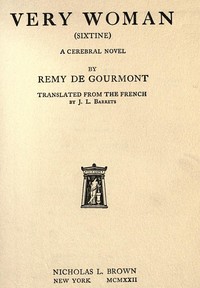
Very woman (Sixtine) : a cerebral novel by Remy de Gourmont
Let's set the scene: Paris in the late 1800s, a world of salons and symbolist poetry. Our guide is Hubert d'Entragues, a bookish, introspective writer who prefers the world of ideas to the messiness of people. Then he meets Sixtine Magne—an enigmatic, fiercely intelligent woman who seems to operate on a different plane. She's not just beautiful; she's a conversational sparring partner, a muse, and a riddle all at once.
The Story
Hubert becomes obsessed. But his obsession isn't purely romantic; it's cerebral. The plot isn't driven by grand events or dramatic twists. Instead, it follows Hubert's internal monologue as he pursues Sixtine. He analyzes her every word, agonizes over the meaning behind her silences, and projects his own ideals and intellectual fantasies onto her. The central question isn't really 'Will they end up together?' but 'Does Hubert even want the real Sixtine, or just the perfect version he's created in his head?' Their relationship is a dance of intellects, full of intense conversations and psychological maneuvering.
Why You Should Read It
This book is a masterclass in writing about thought. Remy de Gourmont captures that exhausting, exhilarating process of overanalysis perfectly. Hubert is often insufferable—he's neurotic, self-absorbed, and frustrating—but you understand him. His struggle feels authentic. Sixtine remains just out of reach, both for Hubert and for the reader, which is the whole point. She's a mirror reflecting Hubert's own mind back at him. The real tension isn't in their courtship, but in watching a hyper-intelligent person try to logic his way through love, only to find that emotions don't follow rules. It's a novel about the loneliness that can come from living too much inside your own head.
Final Verdict
This isn't a book for someone looking for a fast-paced plot or clear-cut romance. It's a slow, rich, and demanding character study. Perfect for readers who love diving into complex psychology, fans of writers like Henry James or the introspective narrators of Dostoevsky, and anyone who's ever felt their brain get in the way of their heart. If you enjoy unpacking a character's motivations more than following action, you'll find 'Very Woman' to be a brilliant, challenging, and surprisingly relatable read from over a century ago.
This digital edition is based on a public domain text. Feel free to use it for personal or commercial purposes.
Michael Hernandez
1 month agoAfter hearing about this author multiple times, the character development leaves a lasting impact. I will read more from this author.
George Walker
1 year agoI came across this while browsing and the content flows smoothly from one chapter to the next. Exactly what I needed.