
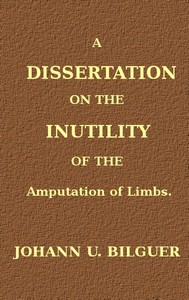
A dissertation on the inutility of the amputation of limbs by Johann Ulrich Bilguer
Let's set the scene: It's the mid-1700s, and Europe is constantly at war. A soldier gets hit by a cannonball or a musket ball, and his arm or leg is a mangled, bloody mess. The standard procedure for battlefield surgeons was brutal and swift: amputation. The idea was to remove the damaged limb quickly to prevent gangrene and death from 'blood poisoning.' The tools were saws and knives, and anesthesia was a swig of whiskey, if you were lucky. Survival rates were abysmal. This was just the grim reality of medicine.
The Story
Into this world steps Johann Ulrich Bilguer, a senior surgeon in the Prussian army. After years of watching young men die after amputations, he started experimenting. He began treating severe limb injuries—even compound fractures where bone pierced the skin—without amputation. He focused on cleaning the wound, setting the bones, and providing careful aftercare. To everyone's surprise, including perhaps his own, his patients started surviving at a much higher rate than those who underwent amputation. This book is his formal report to the world. It's not a narrative with characters; it's a clinical manifesto. He lays out his case with detailed observations and patient statistics, directly challenging the medical establishment. He argues that amputation is often unnecessary, that the body has a powerful ability to heal if given a chance, and that the surgery itself is frequently the cause of death.
Why You Should Read It
This book is gripping because it's a perfect underdog story. It's about data versus tradition. Bilguer isn't a famous philosopher; he's a working doctor on the front lines who kept good notes. His power comes from his evidence. Reading his calm, methodical dismantling of a universally accepted practice is thrilling. You can feel his frustration and his compassion. He saw the human cost of bad medicine and had the guts to speak up. It also makes you think about how many 'standard practices' we accept today that might be completely wrong. It's a powerful reminder to question authority, even (or especially) scientific authority.
Final Verdict
This is a niche book, but its appeal is broad. It's perfect for history buffs who want to see the gritty reality of pre-modern life, or for anyone in medicine who wants a dose of historical humility. It's also great for readers who love stories of quiet rebellion and paradigm shifts. Don't expect a novel—it's a scientific treatise. But within its formal 18th-century language beats the heart of a radical, fighting to save lives against all conventional wisdom. It's short, shocking, and profoundly human.
This masterpiece is free from copyright limitations. Share knowledge freely with the world.
Charles Walker
1 year agoGreat digital experience compared to other versions.
George Harris
6 months agoAs someone who reads a lot, the character development leaves a lasting impact. Worth every second.
Donna Jackson
9 months agoEssential reading for students of this field.
Matthew Taylor
1 year agoI started reading out of curiosity and the content flows smoothly from one chapter to the next. Exceeded all my expectations.


Christopher Taylor
7 months agoThis book was worth my time since it creates a vivid world that you simply do not want to leave. Highly recommended.