
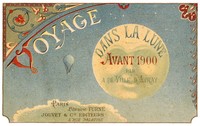
Voyage dans la lune avant 1900 by A. de Ville D'Avray
Let's set the scene: It's the late 1800s. The Baltimore Gun Club, a group of American artillery enthusiasts bored after the Civil War, hatches the most audacious plan imaginable. They will build a colossal cannon, cast a hollow aluminum projectile, and shoot three men at the moon. The crew includes the club's president, the stoic Impey Barbicane; his rival, the fiery Captain Nicholl; and a last-minute addition, the charismatic and fearless Frenchman, Michel Ardan, who volunteers as the human payload. After a global fundraising campaign and incredible engineering feats, they blast off from Florida in a scene that is both thrilling and absurdly dangerous.
The Story
The journey itself is a mix of scientific guesswork (gravity, air supply) and sheer adventure. After a surprisingly smooth trip, their projectile is captured by the moon's gravity and crash-lands. The explorers discover that the moon is not a barren rock. They find a breathable atmosphere trapped in deep craters and, most astonishingly, an entire civilization of insect-like humanoids, the Selenites. These beings live in vast underground cities, and their society is a hyper-efficient, specialized hive. Every Selenite is bred for a single task. The explorers are captured, and their attempts to communicate lead to a mix of wonder, confusion, and peril. The story becomes a race to understand the rules of this strange world and find a way to escape before they are either dissected by Selenite scientists or trapped forever.
Why You Should Read It
What grabbed me wasn't just the adventure (which is fantastic), but the book's sly humor and sharp observations. Ardan, with his artist's soul and disdain for pure logic, constantly clashes with the more rigid Barbicane and Nicholl. Their dynamic is hilarious and feels very real. The satire of the Selenite society—where individuals are reduced to their function—is a brilliant critique of extreme industrialization, written long before it became a common sci-fi trope. You're constantly smiling at the audacity of it all. The 'science' is charmingly wrong, but the spirit of curiosity and the questions it raises about exploration, first contact, and what makes us human are timeless.
Final Verdict
This book is a pure delight for anyone who loves the roots of science fiction. It's perfect for history buffs who enjoy seeing where our modern space-age dreams began, and for readers who appreciate classic adventure with a smart, satirical edge. It's short, imaginative, and moves at a breakneck pace. Don't go in expecting hard science; go in for the wonder, the humor, and the sheer joy of a truly original idea. Think of it as a fascinating conversation with a brilliant, eccentric mind from the past—one who looked at the moon and saw not just a rock, but a story waiting to be told.
This title is part of the public domain archive. Distribute this work to help spread literacy.
Joseph Wright
10 months agoNot bad at all.
Ava Martinez
5 months agoHonestly, the emotional weight of the story is balanced perfectly. Don't hesitate to start reading.
Liam Robinson
4 months agoFinally a version with clear text and no errors.
Mason Taylor
1 year agoClear and concise.







Michelle Nguyen
1 year agoVery interesting perspective.